User Guide
Make sure you've completed each step outlined on the Getting Started page before continuing.
Run VTC
To be able to run VTC, place your .wav files in a folder audio_folder and run:
A helper script is also provided at scripts/run.sh. Before using it, open the file in a text editor and change the following variables at the top of the script:
WAVS— set this to the path of the folder containing your.wavfiles (e.g.,WAVS="/home/user/my_project/audio")OUTPUT— set this to the path where you want the results saved (e.g.,OUTPUT="/home/user/my_project/output")DEVICE— set this to the hardware you want to use:cpu,cuda(for NVIDIA GPUs), ormps(for Apple Silicon Macs)
Then run the script:
For more arguments check the Command Line Interface Arguments section.
Understanding outputs
After running VTC, you get the following structure on disk with the 📂 rttm/ folder containing one RTTM file per audio.
<output_folder>/
├── 📂 rttm/          # Final segments (one .rttm file per audio)
└── 📄 rttm.csv       # Final segments as a single CSV
VTC produces results in two formats: a single CSV file and individual RTTM files. Both contain the same information — use whichever is more convenient for your workflow.
RTTM format
The 📂 rttm/ folder contains one RTTM file per audio file. RTTM is a standard format in speech processing. Each line represents one detected speech segment:
uid (the filename), start_time_s (when the segment starts, in seconds), duration_s (how long it lasts, in seconds), and label (the speaker type: KCHI, OCH, MAL, or FEM).
The remaining fields are placeholders (1 and <NA>) required by the RTTM format specification but not used by VTC.
CSV format (recommended)
Use rttm.csv for analysis.
You can open it in any spreadsheet application or preferably load it as a dataframe using R or Python. Each row is one speech segment with the same four relevant fields as the RTTM format: a filename (uid), start time (start_time_s), duration (duration_s), and the assigned speaker label (label).
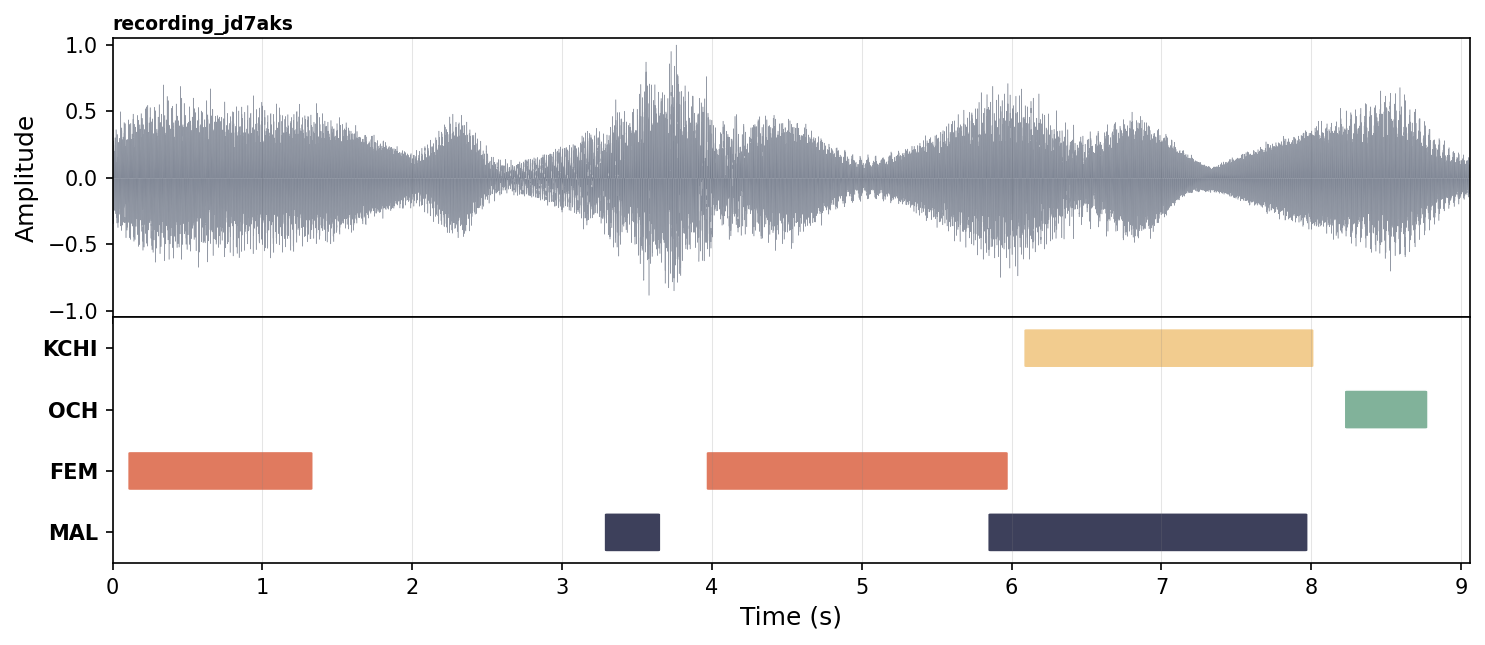
Here is an example of a few detected segments, followed by an illustration of what those segments look like when laid out on a timeline. This visualization is provided here for explanatory purposes only — VTC does not generate this image. You will only receive the CSV and RTTM files described above.
uid,              start_time_s, duration_s, label
recording_jd7aks,         0.12,       1.20,   FEM
recording_jd7aks,         3.30,       0.34,   MAL
recording_jd7aks,         3.98,       1.98,   FEM
recording_jd7aks,         5.86,       2.10,   MAL
recording_jd7aks,         6.10,       1.90,  KCHI
recording_jd7aks,         8.24,       0.52,   OCH
Raw (unprocessed) output
The 📂 raw_rttm/ folder contains the raw RTTM segments detected by the models before any post-processing has been applied (that merges short adjacent segments and removes isolated detections). They're mostly provided for debugging or custom pipelines.
You MUST use the --keep_raw argument when running VTC to get the raw RTTM files, otherwise the pipeline does not keep the files.
Speed
| Setup | Speedup | 1h audio | 16h audio |
|---|---|---|---|
| H100 GPU, batch 256 | 1/905 | ~4 sec | ~1 min |
| A40 GPU, batch 256 | 1/650 | ~6 sec | ~1.5 min |
| CPU (Xeon Silver), batch 64 | 1/16 | ~4 min | ~1 hour |
GPU processing is strongly recommended for large corpora. If you get out-of-memory errors, reduce the batch size.
To change the batch size, add the --batch_size argument to your command. The default is 128. For example, to use a batch size of 64:
uv run scripts/infer.py      \
    --wavs <audio_folder>    \
    --output <output_folder> \
    --device cuda             \
    --batch_size 64
Larger batch sizes are faster but require more memory. If VTC crashes with a "CUDA out of memory" error, try lowering the batch size (e.g., 64 or 32) until it runs successfully.
Command Line Interface Arguments
Here is the complete list of arguments you can use when running VTC.
Argument |
Default | Description |
|---|---|---|
--config |
VTC-2.0/model/config.yml |
Config file to be loaded and used for inference. |
--checkpoint |
VTC-2.0/model/best.ckpt |
Path to a pretrained model checkpoint. |
--wavs |
required. | Folder containing the audio files to run inference on. |
--output |
required | Output path to the folder that will contain the final predictions. |
--uris |
— | Path to a file containing the list of URIs to use. |
--save_logits |
False |
Save the logits to disk. Can be memory intensive. |
--thresholds |
— | Path to a thresholds dict to perform predictions via thresholding. |
--min_duration_on_s |
0.1 |
Remove speech segments shorter than that many seconds. |
--min_duration_off_s |
0.1 |
Fill same-speaker gaps shorter than that many seconds. |
--batch_size |
128 |
Batch size for the forward pass of the model. |
--recursive_search |
False |
Recursively search for .wav files. May be slow. |
--device |
cuda |
Device to use. Choices: gpu, cuda, cpu, mps. |
--keep_raw |
False |
Keep raw RTTM and save to <output>/raw_rttm/. |
| ### Example commands |
Basic usage on CPU — process all .wav files in my_audio/ and save results to my_output/:
GPU with a smaller batch size — useful if your GPU has limited memory:
Search subfolders for audio files — if your .wav files are organized in subdirectories (e.g., one per participant):
Keep raw (unprocessed) output — save the pre-post-processing RTTM files for debugging or custom analysis:
Filter out very short segments — ignore detected segments shorter than 0.2 seconds and fill same-speaker gaps shorter than 0.15 seconds: